 NepovaLMS
Best LMS Provider in Nepal: How to Choose the Right One (2026)
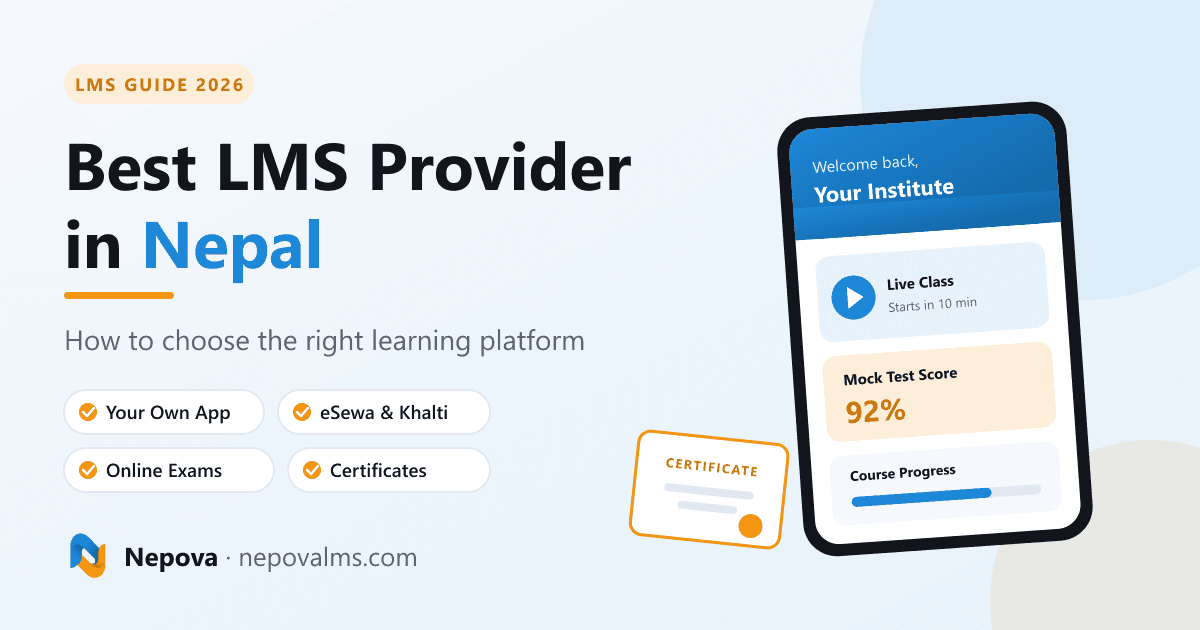
Schools, colleges, coaching centres and companies across Nepal are moving their teaching online, and most of them are searching for the same thing: a reliable LMS provider in Nepal. Online classes are no longer just an emergency backup. They're how institutions grow beyond one building, reach students outside Kathmandu, and run exams and certificates without the paperwork.
Many institutions pick the wrong platform. Some choose a foreign tool that doesn't accept eSewa, some take a free install with nobody to call when it breaks, and some end up with a system their teachers never learn to use.
This guide covers what a Learning Management System (LMS) is, what to look for in an LMS provider in Nepal, how much it costs, and the questions to ask before you sign.
What Is an LMS?
A Learning Management System (LMS) is software for creating, delivering and tracking learning online. With an LMS you can:
Upload video lessons, notes and PDFs
Run live classes and keep the recordings
Conduct online exams, quizzes and MCQ tests
Track student attendance, progress and results
Issue digital certificates
Sell courses online and collect payments
Think of it as your school or training centre, open 24 hours a day on every student's phone.
Why Institutions in Nepal Need an LMS Now
1. Students are mobile-first. Most Nepali learners study on Android phones, often on mobile data. A good LMS works smoothly on low bandwidth and offers its own mobile app.
2. You can reach students outside the valley. A coaching centre in Kathmandu can teach Loksewa or entrance-prep students in Jhapa, Dang or Dadeldhura without opening a new branch.
3. Exams and results take less effort. Online MCQ tests are marked automatically and results come out instantly. Teachers save hours every week.
4. Online courses become a new source of income. Recorded courses keep selling long after you've made them. An LMS with eSewa, Khalti or bank payment integration lets you sell them directly.
5. Corporate training is easier to manage. Banks, NGOs, hospitals and IT companies in Nepal use an LMS for staff onboarding, compliance training and skill development, with reports showing who finished what.
Global LMS vs. Local LMS Provider in Nepal
Global platforms (Moodle, Teachable, etc.) | Local LMS provider in Nepal | |
|---|---|---|
Payment | Mostly international cards or PayPal | eSewa, Khalti, local banks |
Pricing | USD, often per user | NPR, plans sized for Nepali institutions |
Support | Email tickets in other time zones | Local team, phone and on-site support |
Setup | You install and maintain it yourself | Set up and managed for you |
Branding | Platform branding or extra cost | Your own name, domain and app |
Local context | Generic | Built around Nepali syllabi, Loksewa and entrance prep |
Moodle is free to download, but hosting, setup, customisation and maintenance aren't. Many institutions spend more on fixing a "free" LMS than they would have paid for a managed one.
What to Look For in an LMS Provider in Nepal
1. White-label branding
Students should see your institution, not the software company's. Look for an LMS that runs on your own domain (e.g. learn.yourschool.edu.np) with your logo, your colours and ideally your own mobile app on the Play Store.
2. A mobile app
A responsive website isn't enough. A dedicated Android and iOS app with push notifications keeps students engaged and coming back.
3. Live classes and recorded video
You should be able to run live sessions and store the recordings. Recorded video should be protected so it can't be easily downloaded and shared.
4. Online exams
Check for question banks, timed tests, negative marking, randomised questions and instant results. This matters most for Loksewa, IOE, CEE, CMAT and bridge course preparation.
5. Local payment integration
If you plan to sell courses, eSewa and Khalti support is essential.
6. Digital certificates
Auto-generated certificates with your branding and a verification link add credibility for students and employers.
7. Reports and analytics
Attendance, completion rates, test scores and engagement, so you know which students need help and which courses work.
8. Local support and training
Ask who you'll call when something breaks during an exam. A provider based in Nepal can train your teachers in person and respond in your working hours.
9. Data security
Ask where your data is hosted, how often it's backed up, and whether you can export it if you ever leave.
How Much Does an LMS Cost in Nepal?
LMS pricing in Nepal usually depends on:
Number of students or users
Features, such as a mobile app, live classes and payment integration
Branding level: shared platform vs. full white-label
Setup and training
Most local providers offer either a yearly subscription or a one-time setup fee plus a yearly maintenance fee. Always ask for the total yearly cost, not just the starting price, and check whether hosting, updates and support are included.
Who Uses an LMS in Nepal?
Schools for homework, notes, online exams and parent updates
Colleges (TU, KU, PU affiliated) for course materials, assignments and internal assessments
Coaching and Loksewa institutes for recorded classes, mock tests and selling courses nationwide
Training institutes for IT, language, vocational and skill courses with certificates
Corporates, banks and NGOs for staff onboarding and compliance training
Questions to Ask Before Choosing an LMS Provider
Can I use my own domain and get my own mobile app?
Do you support eSewa and Khalti?
How many students can use the platform at the same time during an exam?
Is my video content protected from downloading?
What's included in the yearly fee: hosting, updates, support?
Do you train our teachers?
Can I export my data if I leave?
Can I speak to an existing client?
Why Nepova Is a Trusted LMS Provider in Nepal
Nepova is a white-label Learning Management System built for schools, colleges, training institutes and enterprises across Nepal. With Nepova you get:
Your domain, your app, your brand. Students see only your institution.
Online classes, exams and certificates in one platform
Local payment integration for selling courses
A local team for setup, training and ongoing support
Whether you're a school going digital for the first time or a coaching centre ready to sell courses nationwide, Nepova gives you a complete eLearning platform without the technical headaches.
Book a free demo and see how Nepova can work for your institution.
Frequently Asked Questions
What is the best LMS provider in Nepal?
The best LMS provider depends on your needs. For most Nepali institutions, look for a local provider that offers white-label branding, a mobile app, eSewa/Khalti integration and local support. Nepova offers all of these.
How much does an LMS cost in Nepal?
Costs depend on student numbers, features and branding. Most providers charge a yearly subscription in NPR. Ask for the total yearly cost, including hosting and support.
Is Moodle free in Nepal?
Moodle software is free, but you still pay for hosting, setup, customisation and maintenance. Many institutions find a managed local LMS cheaper over time.
Can I sell online courses in Nepal using an LMS?
Yes. An LMS with eSewa and Khalti integration lets you sell courses directly to students across Nepal.
Can I get my own mobile app with an LMS?
Yes. White-label LMS providers like Nepova can publish an app under your institution's name on the Play Store and App Store.